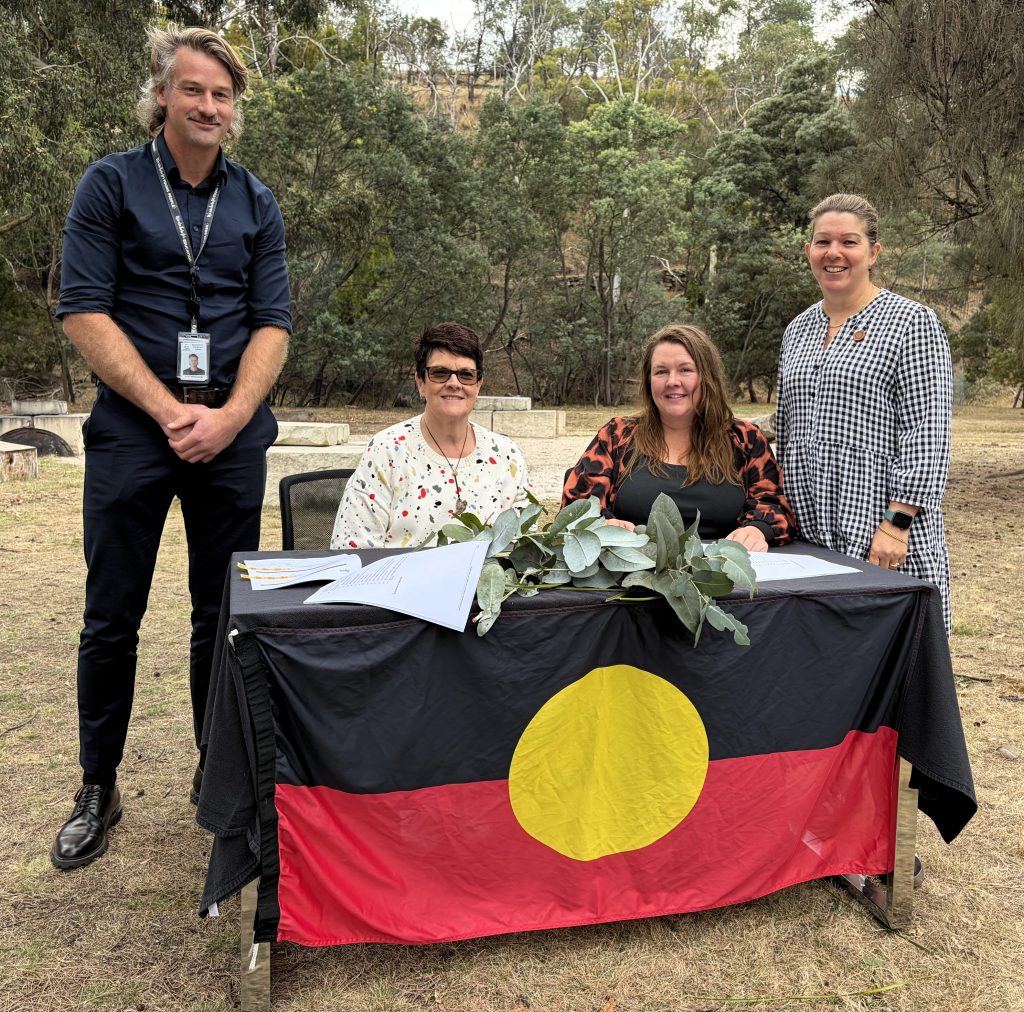
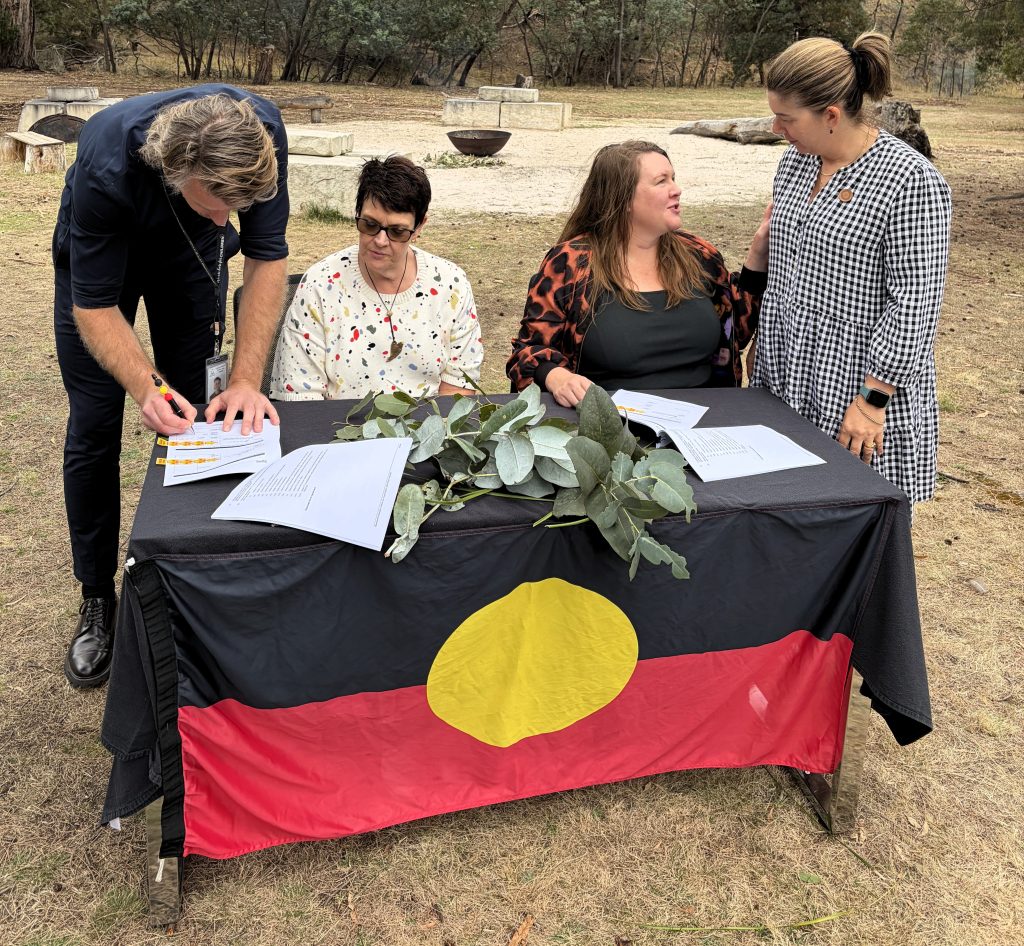
Caption: The Nukara funding agreement was signed by representatives of the Tasmanian Government and the Tasmanian Aboriginal Centre on Returned Aboriginal Country at Piyura Kitina / Risdon Cove. From left: Peter Whitcombe, Deputy Secretary, Child Safety and Youth Justice; Ginna Webster, Secretary of the Tasmanian Department for Education, Children and Young People (DECYP); Rebecca Digney, CEO, Tasmanian Aboriginal Centre (TAC), and Wendy Moore, TAC Nukara Project Manager.
For the first time, the Tasmanian Aboriginal Centre (TAC) and the Tasmanian Government have entered into an agreement to support an Aboriginal Community‑designed and Community‑led model of care and support for Lutruwita’s / Tasmania’s Aboriginal children, young people and families.
“Nukara is about connecting Aboriginal children with family, community and culture to reduce the number going into the child protection system,” said Wendy Moore, Nukara Project Manager, Tasmanian Aboriginal Centre.
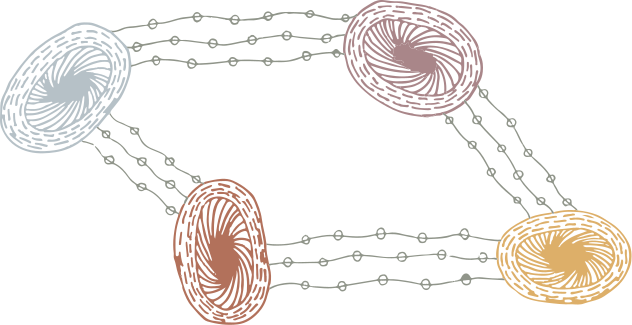
“Nukara, meaning ‘to weave’ in Palawa Kani, brings together culture, community knowledge and practical support into an Aboriginal‑designed suite of programmes that provide culturally safe connection and care for Tasmanian Aboriginal children, young people and families. Nukara is underpinned by the Tirrina model, meaning ‘to weave a basket’ in Palawa Kani, which represents the intentional gathering and weaving of relationships, resources and knowledge to create a strong basket that safely holds Aboriginal children and their families.”
“This milestone agreement is powerful, not just for Tasmanian Aboriginal children, young people and families, but for Aboriginal self-determination more broadly. It demonstrates what is possible when Aboriginal empowerment is backed by government commitment,” said Ms Moore.
The agreement marks the first time in Lutruwita / Tasmania that a government has funded an Aboriginal Community Controlled Organisation to design, from the ground up, a model created by the Aboriginal Community.
“Nukara shows what’s possible when governments trust Community to lead. This is not delegated authority; it’s a genuine step toward Aboriginal self-determination in Lutruwita / Tasmania. Community was asked not just to deliver a model, but to design it,” said Wendy Moore.
Through the Nukara program, the TAC has been supported to articulate what self-determination looks like in practice, what government must do differently, and what legal, policy and systems change is required to make that transition real over time.
While Aboriginal Community Controlled Organisations in other jurisdictions, including Victoria and Queensland, have made important progress through delegated authority within existing government-designed legislative frameworks, Nukara goes further.
Rather than simply being asked to operate within structures designed by government, the TAC and Community were asked to answer the harder and more fundamental questions: What does the Aboriginal community need? What must government do differently? What changes are required across systems and institutions to support a genuine shift to Aboriginal self-determination?
The significance of the agreement lies not only in the funding commitment, but in the principle behind it, that Aboriginal people are best placed to define the structures, supports and reforms needed to keep Aboriginal children strong in culture, family and community.
Nukara sets out a pathway for how a transition to Aboriginal self-determination in Lutruwita / Tasmania can be realised through trust, courage, strong relationships and collective leadership. It identifies the changes required across law, policy, systems and institutions so that Community-led solutions become the norm, not the exception.
The Nukara strategy led to the Nukara program, which launched last year.