Hear Palawa voices give speeches in palawa kani.
To see more speeches and videos in palawa kani, visit our YouTube channel at palawa kani playlist on YouTube (external link).
200th Anniversary Commemoration of “Dick” and “Jack”
Commemorating ‘’Jack’’ and ‘’Dick’’ 200 years on
24 September 2026
Treasury building Nipaluna
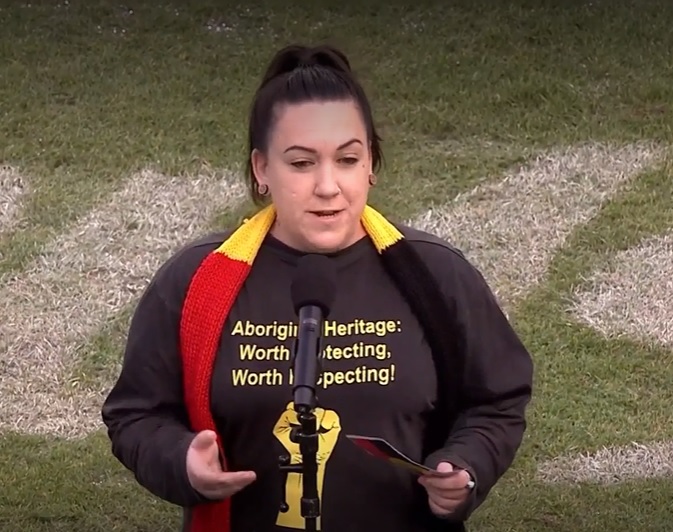
Nala Mansell
Ya pulingina, pulingina palawa. Pulingina raytji karati waranta takamuna lumi.
Mina Nala Mansell, mina wanapakalali palawa centre. Mina kani nayri nina-tu takamuna rrala waranta tunapri & ningina nayri payliti tunapri ‘’Jack’’ & ‘’Dick’’ and palawa ningampi, nungampmi prungi manta krakapakaka mulaka by raityji
Hello and welcome, Welcome to palawa and welcome to our non-Aboriginal friends and allies who are here with us today.
I’m Nala Mansell, from the Tasmanian Aboriginal Centre, and I sincerely thank you all for being here today to acknowledge and pay our respects to these two men, and to the many hundreds of innocent palawa whose lives were taken during the British invasion of Tasmania.
Dick and Jack were born into loving families forming the oyster bay people, the largest Aboriginal nation in Tasmania. They grew up surrounded by family and were raised knowing their Country, their culture, their law and their responsibilities to their people.
‘’Dick’’ is likely to have been Tukalunginta’s brother, one of the most feared leaders of the Oyster Bay resistance. ‘’Jack’’ grew up in a society that had existed on this island for thousands of generations.
Dick and Jack weren’t actually their real names, they were the names given to them by white people, and their real names were never recorded.
By the 1820s, the relentless violence of sealers, whalers and ‘’settlers’’ raiding camps, killing men, and abducting women and girls had shattered the ability of the Oyster Bay people to live freely in their own homelands. Their Country was being invaded, their families were being attacked, and their way of life completely destroyed.
In November 1824, Dick and Jack arrived in Hobart as part of a group of about 60 Aborigines led by Kickertepoller, looking for blankets and other provisions. They ended up living at Kangaroo Point, now known as Bellerive.
Then, in 1825, the death of a white colonist near Kangaroo Point sparked outrage amongst the white community. Without any evidence, Governor Arthur presumed an Aborigine must be responsible and a month later, Dick and Jack were plucked from their community and thrown into a cell where they became victims of the colonial justice system.
Dick was an elderly and very sick man. He’d been unable to walk and was forced to crawl through the cells on his hands and knees. Jack was a tall and young man; likely to have been in his late teens or early twenties.
The trial took place in May 1826, lasting two days, and the proceedings were deeply flawed. They had no understanding of the court process, were refused the right to give evidence because they weren’t Christian and were convicted by an all-white jury.
As news of their impending execution spread, many voices rose in protest. There was a growing recognition among the white community that the two men had been unfairly treated.
Despite these concerns, Governor Arthur justified the hanging with a government notice claiming that it would “prevent further atrocities” and encourage a “conciliatory line of conduct.” This statement reveals a chilling mindset, viewing the lives of Aboriginal people as expendable in the name of maintaining control.
The execution was witnessed by a large crowd, and the Colonial Times published a remarkably detailed and distressing account;
‘’Dick was alive, conscious and resisting when they came to collect him for his execution. The old man was extremely weak, but he resisted . When forced up the gallows he “gave them such a specimen of his vocal endowments that could have been heard half way to Kangaroo Point’’.
He then refused to stand alongside the other six condemned men and insisted on having a seat, squatting on a stool that “dropped as he rested. The awful moment had arrived.”
He died ‘’a very hard death’’ the drop didn’t break his neck and he eventually died by strangulation. Jack was also subjected to a prolonged and violent death. As he hung from the gallows, the cord that had been tied around his hands behind his back slipped up towards his elbow and he was able to raise his hands towards his own neck,blood poured profusely from his nose.
Jack continued to insist on his innocence right to the end. His suffering was “painfully prolonged’’ by an accident that happened at the moment, before strangulation was completed.”
Both men were subjected to a prolonged and extremely violent execution, right here, on this day, 200 years ago.
That building behind you all there was the Supreme Court of Van Diemen’s Land, where Jack and dick were found guilty and sentenced to death for a crime they said they didn’t commit.
And right there just over the road cross was the Hobart Town jail, where they were imprisoned and then hanged to their death.
For 200 years, their story has been part of this place, yet there is no plaque or statue here to honour them, or the many other Aborigines whose history is part of this city and state. Our connection to this place remains as it always has been in this state; hidden, ignored, swept under the rug and never mentioned.
And 200 years later, injustices against Aborigines continue; as I speak, the Tasmanian Government is preparing new Aboriginal heritage laws that deny us ownership and authority over our own heritage, while white people have full ownership, control and protection over theirs. The Liberal will soon attempt to make this racial discrimination part of Tasmanian law.
Today, we put Dick and Jack back where they belong; at the centre of Tasmanian history.
We can’t change what happened to them, but we can refuse to forget them
We will remember Dick and Jack, speak their names, and tell the truth about what happened to our people during the British invasion of this island.
Two hundred years ago, Dick and Jack were killed right here.
Today, we have brought their names back to this place but remembering them is not enough. Our people and our history must be permanently recognised, and our heritage must be owned, controlled and protected by our people.
We will not support racist heritage laws that continue to deny our ownership and authority over our own heritage.
Dick and Jack will be remembered.
Our people will be remembered.
And our heritage is not yours to control.
Thank you everyone for coming.”
Pulingina, AFLW Welcome to Country, Launceston, September 2022
Daisy Allen welcomes the AFLW North Melbourne and Geelong players to Launceston.
(1) Facebook (links to TAC Facebook post)
Pulingina MONA FOMA, Launceston, January 2020
Watch Daisy Allan give a powerful pulingina (welcome) in palawa kani, the language of Tasmanian Aborigines at the opening of FOMA MONA, Launceston, January 2020.
TMAG Children’s Festival, Nipaluna, April 2018
Ada Marshall (aged seven) and Cooper Marshall (aged 11) pulingina for TMAG Children’s Festival in Nipaluna (Hobart), April 2018.
Takayna, on Country Exhibition, February 2018
The Wilderness Society held an Aboriginal Art Exhbition in Launceston on 1 February 2018, to raise funds for the protection of takayna.
This welcome, spoken in palawa kani by Daisy Allen, was given at the event.
Invasion Day, 2016
Hear Daisy Allen give a spirited speech in palawa kani to mark Invasion Day at Parliament Lawns in Nipaluna/Hobart, 26 January 2016.