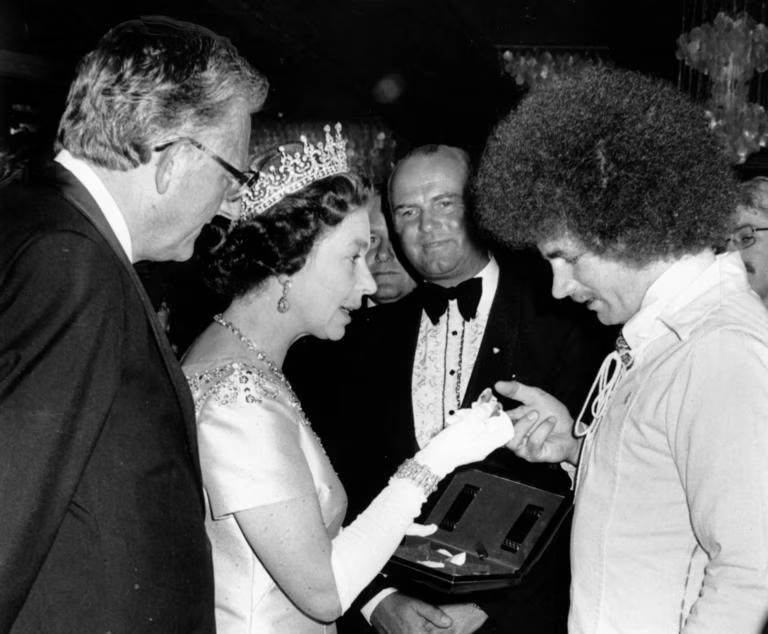
Michael Mansell shows Aboriginal cultural heritage items to the Queen in 1977
by Michael Mansell
For decades, Tasmanian governments have refused to co-design Aboriginal heritage laws with the Aboriginal community. The fundamental issue is ownership. Aboriginal people believe the cultural heritage created by our ancestors should belong to Aboriginal people, just as European heritage belongs to those who created it and their descendants.
European cultural heritage whether paintings, buildings, monuments or other historic places remains the property of those who created it. For example, the works and property of John Glover belonged to him and could be sold, inherited, or passed on to future generations.
Yet Tasmanian law treats Aboriginal heritage differently. Since the Aboriginal Relics Act 1975, and continuing through subsequent legislation and the Government’s draft Aboriginal Heritage Bill 2026, Aboriginal people have been denied ownership of the cultural heritage created by our ancestors. Rock carvings, middens, cultural sites and other heritage are effectively controlled by the State rather than the descendants of those who created them.
This double standard is rooted in the same colonial thinking that justified the dispossession of Aboriginal people. While European labour and creativity gave rise to recognised property rights, Aboriginal cultural heritage was taken along with the land. It is unacceptable that this approach remains embedded in legislation in 2026.
Just as native title overturned the legal fiction of terra nullius, new Aboriginal heritage laws must clearly recognise ongoing Aboriginal ownership of Aboriginal cultural heritage.
While Minister Bridget Archer has publicly acknowledged that Aboriginal heritage belongs to Aboriginal people, the draft Bill fails to reflect this principle. Our key concerns include:
- Section 8 of the Bill describes Aboriginal people as “spiritual custodians” rather than owners. This language recognises a connection but creates no meaningful rights. The legislation should instead explicitly recognise Aboriginal ownership and the associated rights to use, protect, manage and pass heritage on to future generations.
- Intangible heritage such as oral traditions, stories, songs, dances, cultural knowledge, rituals and traditional practices are largely excluded from protection.
- Access rights are not guaranteed. Section 10(3) may restrict Aboriginal access to cultural areas, including Crown land containing Aboriginal heritage. The Act should guarantee cultural access and require good-faith negotiations with private landowners.
- Compulsory acquisition powers remain. Section 30 allows the Minister to acquire Aboriginal heritage sites on behalf of the Crown, without requiring ownership to be transferred to Aboriginal people. No equivalent power exists for European heritage under Tasmania’s Historic Cultural Heritage Act.
- The Aboriginal Heritage Council remains a government-created advisory body rather than an Aboriginal-controlled authority. Aboriginal people should determine who represents and manages Aboriginal heritage interests.
- Cultural landscapes are only protected if registered, and the Bill fails to adequately recognise Aboriginal heritage as living cultural relationships, knowledge systems, practices and connections to Country.
- Broad regulation-making powers could allow future governments to weaken protections through regulations without full parliamentary scrutiny or Aboriginal consent, including exemptions for activities, permits and management requirements.
The Aboriginal community is calling for a Bill that is co-drafted with Aboriginal people and that begins by recognising a simple principle: Aboriginal cultural heritage belongs to the Aboriginal people whose ancestors created it. Only once ownership is properly recognised should planning and management processes be developed.